CLICK HERE FOR BLOGGER TEMPLATES AND MYSPACE LAYOUTS »

Tuesday, January 12, 2010

I'm here to tell you about one of my New Year's Resolutions.

By the end of 2010, I want to have helped 100 unfortunate people. :)

It doesn't sound a lot, but if you compute, that's a person every three days. That's around 2 people a week. And we're in the middle of the first month of the year and I haven't helped anyone yet.

Today, I gave my first loans on Kiva. I'm supporting a group of poor entrepreneurs in Isabela so they could expand their fruits and vegetable business. And I'd give out another one to a group in Ghana once I reload my account, short of only a 100 bucks. Those two loans, I think, only count as two people since I'm technically loaning out the money to just one of them. Their pictures are at the end of the entry, :)

I found Kiva through Time.com, who listed it as one of the best websites of 2009. It's a microfinance website that partners with institutions all around the world. These field partners scout for unfortunate people who need a few thousand pesos to start or expand their business, but can't get a loan from the bank because financial institutes don't recognize them. Kiva posts their request online, and then people all over the world could lend them the money they need. You can loan for as little as $25.

You'll get your money back in a few months. Of course, you don't get your money back if they don't pay. Amazingly, the Kiva notes return rate is 98%, higher than the return rate of bank. 98% of the money l0aned out are returned. In microfinance, the figures are usually like that. :)

This isn't charity because they'll be giving back the loan. But the best part about this is that microfinance combats poverty by empowering people I read in a book that entrepreneurship is one of the best ways people escape poverty. These people make the initiative to change their lives, and we just help them along.

Of course, this isn't the only thing I'd do to help out people this year. I'd want to volunteer and hurl my pale ass out into the sun. But this isn't the point of this entry.

It's about how sometimes we mistake aspiring for something to be doing something about it.

These past few months, I've been served my share of hard philosophers. And by hard, I mean philosophers who have a no-nonsense philosophies that do not console you for your troubles but instead challenge you to make your life your own. No moaning. No excuses. No whining. At the head of this uncompromising crowd is my first love, Nietzsche (Wait, did Alexander the Great come first?)

Nietzsche dares us to confront life with a yes, that we should not hide behind rationalizations and sour-graping, that we should not blame others for our own weaknesses. To see what we want, and to seize it. Sartre says that the sum of man is his actions, and all other excuses and unrealized aspirations count for nothing. And lately, I read Freud,

"The dream takes the place of action, as elsewhere in life"

It's not pleasant to read these philosophies, I tell you. It plants a seed of discontent somewhere within the valleys of your indolent soul. It tells you to push, move, heave, and if need be, crawl. And when I've thought about what had made be latent in my life, it wasn't at all that I had no ambition. I do have them, I have a lot. But that I lacked the discipline to pursue them.

In Screwtape Letters, the demon mentor was instructing his demon mentee on how to secure the damnation of his 'patient':

"You must keep on shoving virtues outward till they are finally located in the circle of fantasy... It is only insofar as they reach the will that they are really fatal to us. All sorts of virtues painted in the fantasy or approved by the intellect or even, in some measure, loved, and admired, will not keep a man from Our Father's house [Hell]: indeed they make him more amusing when he gets there."

There are a bajillion things I want to do in this life. One of them is this: to make a positive dent in the world. And I'm starting, in my own little way. And I hope, I help, even if only a little, in making a difference in a few people's lives.


Alice Breto's main source of income comes from selling fruits and vegetables. She is 49 years old, married and has 10 grown-up children. She is from the village of Sta. Maria, Cauayan City, Isabela. Alice has been in her business for over 15 years and earns approximately 6,000 Philippine pesos (PHP) a month.

Alice is the leader of a 10 member group accessing a loan offered by ASKI. While each member of the group receives an individual loan, they are collectively responsible for paying back the loans of their fellow group members, if someone is delinquent or defaults.

And this is the second group I'm lending money to. Unfortunately, my account was short of a hundred pesos. Tomorrow!


Abena is a 30-year-old married mother of seven children. All of her children are in school. She lives with her husband and children in a rented apartment in a commercially-dominated community. Abena is a food vendor. She prepares and sells 'kenkey', a traditional staple food made with corn and cassava. Abena is the leader of a trust bank group called 'Nkabom', literally meaning unity. The members of the group are mainly traders. They are hard working, trust themselves and want the loan to invest into their businesses. Abena, the group leader is seated in the middle in the photograph.
Sunday, January 3, 2010

For Marj:


I remember something that I learned something last sem. It's about the in-betweens. It's about the 'lost-ness' in transitions. When something had just ended, there's that moment when you don't know where to go next. It's the not-yet moments in life. When the future is upon us, but not quite.

In-betweens are times when we don't have words, when our vocabularies haven't grown yet to enunciate our new desires, which hangs like a mist in our minds. The future is a haze, and as we propel ourselves to the center, not knowing if there's anything we can grasp or hold on to. :)

Only when we learn new words of talking about the world, we'd look back and see to which direction we were swept away by God, life, or destiny-- whichever you prefer. :) Just got to have faith that the universe will sweep you away to a spot where you could nourish and grow, little critters that we are. :)

And then the fog moves to another spot, another area to conquer. :)

Thursday, December 31, 2009

The dam of cadence breaks
from pitters of the heart
to skipping, soaring thumps.
And the patter of your feet
hurls from bacchanal beats
into the rhythmless dissolution
of stillness.

Thanks, caffeine.

Wednesday, December 30, 2009

"Abby! I want babies"
"You mean 'little bundles of joy?'"
"No, I meant fat little four-legged cuddly, fluffy creatures I could hug that resemble you."

üüü

Tuesday, December 29, 2009

To scatter is easy, to keep whole is another matter altogether.

An interesting coinage of Aristotle is revived by Joe Sachs in his translation of the De Anima. Entelecheia is not a mere synonym of energeia, though even the latter term lacks a counter-part in English. Joe Sachs translates entelecheia as "being-at-work-staying-itself". The awkwardness of the translation demands the reader to pause at the initial meeting with the term, and to resuscitate an insight frequently lost when entehecheia is translated into the usual 'actuality'. The term is from the Greek terms that mean "completion," "continuity" and "persistence." This is probably my most favorite part in the De Anima, it almost inspires in me intellectual giddiness.

Any living being is always active and never inert. For me to be able to lounge unproductively these past few days, my body maintains complex processes, the mysteries of which the best scientists of our century have not yet fully exhausted. The mere maintenance of life requires persistent cooperation of parts. In keeping whole, my parts work; but my part works only in keeping whole. This is the most basic level that enables life to be life.

If you read enough literature (which I haven't been able to do, but will rectify in the coming year), and you get into the substrata of words, you'd find certain themes to recur over and over again. Canonical works work particularly well in transcending particularities in time, space, and culture' and their resiliency is because of their ability to tap into some common nerve of humanity. We could all relate to these' that's why we tell these stories over and over again. (Now that I think about it, Reading the Romance is probably the class which impacted my thinking most).

The push and pull of parts and wholes is one such universal theme.

Perhaps it's characteristic of my generation, to be pulled apart by so many wants, and interests, and activities. Marj would certainly attest to that. There's this restlessness in my peers, and the need to diversify. Dappled, ever-changing media was our milk, way before we were capable of being critical. It shaped, and still continues to shape our minds. The enlightening article in Google before said that how information reaches us alters the way we think. And what may be said of the generation that is weaned in you tube and twitter. Where five-minute sensations seem too long by the third minute? It's surely an invitation to develop ADHD. Things keep on going shorter and shorter.

I'm a child of my age, and I'm similarly torn between multiple interests. So much so that specialization becomes a problem. I'm swimming in the Heraclitan river, with no sight of the Parmendian whole. It's not surprising, therefore, when I would encounter problems with identity. The question of "Who am I?" becomes even more problematic. There's the inner resistance in embracing your occupation, your likes, or your interests as determining handles to identity. But aside from that, these things constantly change anyway. Gone were the days when you could simply say, "Hello, I'm John and I'm a baker." If I am emptied and filled by every passing color and fad...?

Pretty soon, if we lose ourselves in so much movement, we will never be able to remember stillness. If go deeper and deeper into the matter of things; particles become smaller and indistinct and the rest of the universe disappears into the haze of multiplicity.

Isn't this so post-modern? When we've lost any ground on which we can anchor truth. It's how the Copernican revolution removed the Earth as the center of the universe, and put the sun in its stead. But now that the vast expanse of the universe had just revealed itself, the center of the universe is lost. Any place could be the center of the universe. (That's one great insight from Bill Bryson.)
Wasn't this the very Sartrean starting point?

When I think about why I feel the need to dabble in this and that, two answers surface. The first is true: I am interested in the next new thing, the world becomes a wondrous treasure box; there's always something to marvel in. It's also true that it's spurred by a search for security, oddly enough. My lived philosophy about this is that there is safety in numbers, and, just like in stock portfolios, your ass is safer when your investments are diversified. If Sita revolved her life solely around Rama; without Rama, who is she? But if she had something other than Rama, then she would survive without Rama, she could still be Sita. Even if she becomes half, or a quarter. Something of her still remains.

This is the philosophy Horcruxes. (I could write a paper on this!)
I remember Sir Strebel talking about integrity; and how the word integer means whole. To lack integrity is to lack wholeness.

But if your parts were spread about in the universe, is there still a you to speak of?

Monday, December 28, 2009

Latest discovery in the massive treasure chest that is the web:

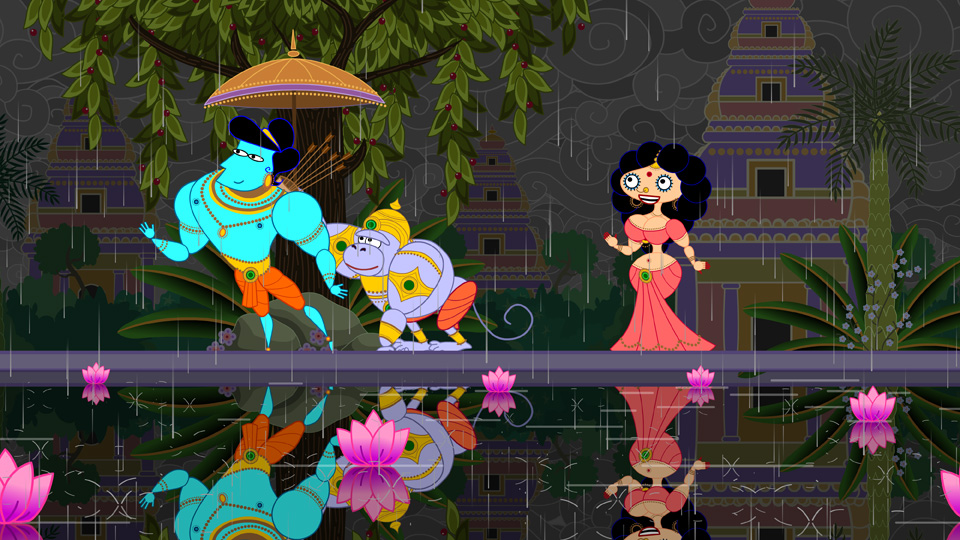
Sita Sings the Blues


It's enchanting and it drew me in the first few minutes. I've always been a sucker for good-lookin' animation styles. And culture. And music. And I'm happy to know that it's been included in Roger Ebert's list of best films of 2009. You've got to see it to love it; and all you need is a little backstage trivia to completely fall in love.

Sita Sings the Blues is a retelling of the famous Indian epic Ramayana, and the subtitle is "The Greatest Break-Up Story Ever Told". It's a retelling that is sympathetic to Sita, Rama's wife, who suffered great heartbreak when her husband turned cold on her, and eventually shunned her.

Sita sings to the voice of Annette Hanshaw, a famous jazz singer from the 20's. Her voice is rich, and both strong and vulnerable. The lyrics to her songs are strikingly appropriate. They tell the same stories.

The film also has autobiographical bits: the heartbreak the animator, the brilliant Nina Paley, went through when her marriage disintegrated. Nothing is contrived, you know it comes from her heart (I read that animation is a kind of catharsis for Nina Paley.) It's her picking up the pieces and moving on. She showed her grief in the film, but implicit message of success of having moved on is the film itself.
I've nothing but admiration of any artist who is deeply passionate about her art. And it's never about the money. That's why Sita Sings the Blues is under a Creative Commons license, and

It's fascinating how Nina Paley seamlessly integrated different animation techniques, cultures and time periods and weaved them into a single thread. The film was not shy in invoking emotions, either; I've had my fair share of laughter at the three shadow-puppet commentators. The colors of the threads remain striking because they remain individuated. But the parallels running between these intertwining threads highlight the universal themes of separation, love, and heartbreak.

Sita Sings the Blues pulsate seamlessly into the realm of personal and the universal. Canonical works, after all, retain tenacity because anyone could relate to them, regardless of culture or era. :)

*will fix this review later*

Saturday, December 26, 2009

I just read a few old entries from this blog for a friend. I'm glad I kept a journal during those times, trying as they may be. It gives me the sense that nothing is lost. A historian is a keeper of memories; and I suppose its part of the grand effort of keeping things whole and not letting anything pass you by-- arguable, my methods might be.

I'm writing in this blog again, though I said to myself a couple of weeks or months ago that this affair had gone on long enough. I'm not going to promise to myself that I will rekindle this blog. I said elsewhere that I ought to attend to matters outside of myself. Introspection can only take you so far, but never enough-- perhaps that is Fr. David's sentiments about it.

Marjorie and I have a Christmas tradition. For three years now, we would take a walk around our village on Christmas eve, vagabonds as we are. I'd stay at her place for a couple of hours, her family has come to expect me during Christmas eve. Marj's sister was looking for me when I came a little later than usual. That warms my heart.
There's always something new. And this part of Christmas is what saves the rest from collapsing into a burning heap of failed expectations-- it's not unusual when matters of the home and hearth are concerned. But Christmas has been good this year, and that is a pleasant surprise.

And I'm especially glad of the distinct flavor left by our spontaneous trip to Tagaytay- Marj, Baquib and me. There are two aching hearts in that black sports car; and they badly needed the soothing cold, Christmas-y breeze of Tagaytay and the breaking of beautiful dawn over Taal Lake and our prayers.

Suddenly, I want to write again. Being with Marj unfailingly reminds me about growing up. And the situation where she finds herself in-- it reminds me of how messy life could be. Things never turn out the way we expect them; and I'm always, always disappointed from the little things to the bigger things.
And this is Las-Pinas to me. It's a mess, that I more often hate than love. But it could be beautiful, it could be beautiful. Katipunan is the blank slate on which I plan the great escape from my past, it's where I draw itineraries for my future. My Katipunan is a life that is mine, it is not messy, it is not complicated. And I would still choose it above my life in Las Pinas any day.

But that is not the place where I could write.
The truth of the matter is that my art does not spring where I am not hurting. And now I'm lulled into content, peaceful sleep . But I'm haunted with a vague sense of longing. Don't get me wrong, I'm blissfully happy and reveling in my new found security and love with Oli. It's just that I've that old melancholic tic of seeing poignancy in sadness and the darker sides of the emotional spectrum. (I was emo before they invented the term, but I'd flee from it like a plague if anyone pulls that label on me.)

I want to write even when I am happy. These are the happy days when my heart still blossoms and blooms and bursts into spring whenever Oli smiles at me. I want to write because I miss writing and I genuinely like writing. I want to write because I want to and I have as much as a right as anyone else in the world to pursue what makes me happy.

I would want to section off that huge block of inactivity. If blogger would permit it, I'd put the past in another folder and declare this as a new beginning, Januaries are always testaments to resolutions. That betrays a likeness to Aristotle-- that taxonomical impulse to organize. I don't want my life messy. But it is. Will I choose to revel in this mess?