The dam of cadence breaks
from pitters of the heart
to skipping, soaring thumps.
And the patter of your feet
hurls from bacchanal beats
into the rhythmless dissolution
of stillness.
Thanks, caffeine.
Thursday, December 31, 2009
Wednesday, December 30, 2009
"Abby! I want babies"
"You mean 'little bundles of joy?'"
"No, I meant fat little four-legged cuddly, fluffy creatures I could hug that resemble you."
üüü
Tuesday, December 29, 2009
To scatter is easy, to keep whole is another matter altogether.
An interesting coinage of Aristotle is revived by Joe Sachs in his translation of the De Anima. Entelecheia is not a mere synonym of energeia, though even the latter term lacks a counter-part in English. Joe Sachs translates entelecheia as "being-at-work-staying-itself". The awkwardness of the translation demands the reader to pause at the initial meeting with the term, and to resuscitate an insight frequently lost when entehecheia is translated into the usual 'actuality'. The term is from the Greek terms that mean "completion," "continuity" and "persistence." This is probably my most favorite part in the De Anima, it almost inspires in me intellectual giddiness.
Any living being is always active and never inert. For me to be able to lounge unproductively these past few days, my body maintains complex processes, the mysteries of which the best scientists of our century have not yet fully exhausted. The mere maintenance of life requires persistent cooperation of parts. In keeping whole, my parts work; but my part works only in keeping whole. This is the most basic level that enables life to be life.
If you read enough literature (which I haven't been able to do, but will rectify in the coming year), and you get into the substrata of words, you'd find certain themes to recur over and over again. Canonical works work particularly well in transcending particularities in time, space, and culture' and their resiliency is because of their ability to tap into some common nerve of humanity. We could all relate to these' that's why we tell these stories over and over again. (Now that I think about it, Reading the Romance is probably the class which impacted my thinking most).
The push and pull of parts and wholes is one such universal theme.
Perhaps it's characteristic of my generation, to be pulled apart by so many wants, and interests, and activities. Marj would certainly attest to that. There's this restlessness in my peers, and the need to diversify. Dappled, ever-changing media was our milk, way before we were capable of being critical. It shaped, and still continues to shape our minds. The enlightening article in Google before said that how information reaches us alters the way we think. And what may be said of the generation that is weaned in you tube and twitter. Where five-minute sensations seem too long by the third minute? It's surely an invitation to develop ADHD. Things keep on going shorter and shorter.
I'm a child of my age, and I'm similarly torn between multiple interests. So much so that specialization becomes a problem. I'm swimming in the Heraclitan river, with no sight of the Parmendian whole. It's not surprising, therefore, when I would encounter problems with identity. The question of "Who am I?" becomes even more problematic. There's the inner resistance in embracing your occupation, your likes, or your interests as determining handles to identity. But aside from that, these things constantly change anyway. Gone were the days when you could simply say, "Hello, I'm John and I'm a baker." If I am emptied and filled by every passing color and fad...?
Pretty soon, if we lose ourselves in so much movement, we will never be able to remember stillness. If go deeper and deeper into the matter of things; particles become smaller and indistinct and the rest of the universe disappears into the haze of multiplicity.
Isn't this so post-modern? When we've lost any ground on which we can anchor truth. It's how the Copernican revolution removed the Earth as the center of the universe, and put the sun in its stead. But now that the vast expanse of the universe had just revealed itself, the center of the universe is lost. Any place could be the center of the universe. (That's one great insight from Bill Bryson.)
Wasn't this the very Sartrean starting point?
When I think about why I feel the need to dabble in this and that, two answers surface. The first is true: I am interested in the next new thing, the world becomes a wondrous treasure box; there's always something to marvel in. It's also true that it's spurred by a search for security, oddly enough. My lived philosophy about this is that there is safety in numbers, and, just like in stock portfolios, your ass is safer when your investments are diversified. If Sita revolved her life solely around Rama; without Rama, who is she? But if she had something other than Rama, then she would survive without Rama, she could still be Sita. Even if she becomes half, or a quarter. Something of her still remains.
This is the philosophy Horcruxes. (I could write a paper on this!)
I remember Sir Strebel talking about integrity; and how the word integer means whole. To lack integrity is to lack wholeness.
But if your parts were spread about in the universe, is there still a you to speak of?
Monday, December 28, 2009
Latest discovery in the massive treasure chest that is the web:
Sita Sings the Blues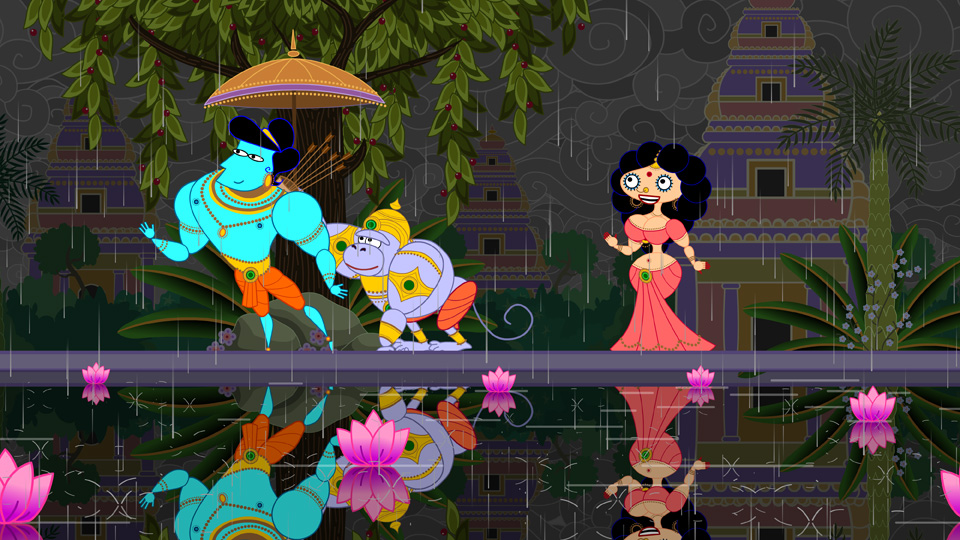
It's enchanting and it drew me in the first few minutes. I've always been a sucker for good-lookin' animation styles. And culture. And music. And I'm happy to know that it's been included in Roger Ebert's list of best films of 2009. You've got to see it to love it; and all you need is a little backstage trivia to completely fall in love.
Sita Sings the Blues is a retelling of the famous Indian epic Ramayana, and the subtitle is "The Greatest Break-Up Story Ever Told". It's a retelling that is sympathetic to Sita, Rama's wife, who suffered great heartbreak when her husband turned cold on her, and eventually shunned her.
Sita sings to the voice of Annette Hanshaw, a famous jazz singer from the 20's. Her voice is rich, and both strong and vulnerable. The lyrics to her songs are strikingly appropriate. They tell the same stories.
The film also has autobiographical bits: the heartbreak the animator, the brilliant Nina Paley, went through when her marriage disintegrated. Nothing is contrived, you know it comes from her heart (I read that animation is a kind of catharsis for Nina Paley.) It's her picking up the pieces and moving on. She showed her grief in the film, but implicit message of success of having moved on is the film itself.
I've nothing but admiration of any artist who is deeply passionate about her art. And it's never about the money. That's why Sita Sings the Blues is under a Creative Commons license, and
It's fascinating how Nina Paley seamlessly integrated different animation techniques, cultures and time periods and weaved them into a single thread. The film was not shy in invoking emotions, either; I've had my fair share of laughter at the three shadow-puppet commentators. The colors of the threads remain striking because they remain individuated. But the parallels running between these intertwining threads highlight the universal themes of separation, love, and heartbreak.
Sita Sings the Blues pulsate seamlessly into the realm of personal and the universal. Canonical works, after all, retain tenacity because anyone could relate to them, regardless of culture or era. :)
*will fix this review later*
Saturday, December 26, 2009
I just read a few old entries from this blog for a friend. I'm glad I kept a journal during those times, trying as they may be. It gives me the sense that nothing is lost. A historian is a keeper of memories; and I suppose its part of the grand effort of keeping things whole and not letting anything pass you by-- arguable, my methods might be.
I'm writing in this blog again, though I said to myself a couple of weeks or months ago that this affair had gone on long enough. I'm not going to promise to myself that I will rekindle this blog. I said elsewhere that I ought to attend to matters outside of myself. Introspection can only take you so far, but never enough-- perhaps that is Fr. David's sentiments about it.
Marjorie and I have a Christmas tradition. For three years now, we would take a walk around our village on Christmas eve, vagabonds as we are. I'd stay at her place for a couple of hours, her family has come to expect me during Christmas eve. Marj's sister was looking for me when I came a little later than usual. That warms my heart.
There's always something new. And this part of Christmas is what saves the rest from collapsing into a burning heap of failed expectations-- it's not unusual when matters of the home and hearth are concerned. But Christmas has been good this year, and that is a pleasant surprise.
And I'm especially glad of the distinct flavor left by our spontaneous trip to Tagaytay- Marj, Baquib and me. There are two aching hearts in that black sports car; and they badly needed the soothing cold, Christmas-y breeze of Tagaytay and the breaking of beautiful dawn over Taal Lake and our prayers.
Suddenly, I want to write again. Being with Marj unfailingly reminds me about growing up. And the situation where she finds herself in-- it reminds me of how messy life could be. Things never turn out the way we expect them; and I'm always, always disappointed from the little things to the bigger things.
And this is Las-Pinas to me. It's a mess, that I more often hate than love. But it could be beautiful, it could be beautiful. Katipunan is the blank slate on which I plan the great escape from my past, it's where I draw itineraries for my future. My Katipunan is a life that is mine, it is not messy, it is not complicated. And I would still choose it above my life in Las Pinas any day.
But that is not the place where I could write.
The truth of the matter is that my art does not spring where I am not hurting. And now I'm lulled into content, peaceful sleep . But I'm haunted with a vague sense of longing. Don't get me wrong, I'm blissfully happy and reveling in my new found security and love with Oli. It's just that I've that old melancholic tic of seeing poignancy in sadness and the darker sides of the emotional spectrum. (I was emo before they invented the term, but I'd flee from it like a plague if anyone pulls that label on me.)
I want to write even when I am happy. These are the happy days when my heart still blossoms and blooms and bursts into spring whenever Oli smiles at me. I want to write because I miss writing and I genuinely like writing. I want to write because I want to and I have as much as a right as anyone else in the world to pursue what makes me happy.
I would want to section off that huge block of inactivity. If blogger would permit it, I'd put the past in another folder and declare this as a new beginning, Januaries are always testaments to resolutions. That betrays a likeness to Aristotle-- that taxonomical impulse to organize. I don't want my life messy. But it is. Will I choose to revel in this mess?
Sunday, November 8, 2009
Heart aches. The cliche is an insult when the sensation is true. Words and images no longer come willingly. You coax them in the rare moments when you remember but they do not come, like children who don't know their own mother. In the far end of the room they bunch together, afraid and uncertain of the stranger their father calls their mother. An awkward hug takes place, tiny voices utter insincere I-missed-you's . And you die a little inside, wonder why you ever left, but you've been estranged the moment you've forgotten blood ties.
The half that learned how to feel sees only the dark.
Pace, pace, pace, wall, pace, pace, wall.
And the words that left you only learned how to say "the twenty-seven names for tears."
The beautiful and terrible Magnussen snorts.
But the truth is, nothing had ever learned how to hold you. And the gentle caress of a few that had unwittingly touched you leaves a trail of scorch.
The world and I grow apart. I go and grow within me. A cancer, malicious mass of cells that insists on growing, blindlingly, blindlessly. In the dark, the abomination grows and causes feelings of displacement. Weighing heavily, the heart grows larger and becomes a monster, unable to pump.
A monster its maker cannot love.
"Wretched devil, you reproach me with your creation; come on, then, that I may extinguish the spark which I so negligently bestowed."
Frankenstein and his son, one and the same?
Wednesday, October 21, 2009
Eight days ago:
Sleepless. Katipunan and her weak streetlamps. Sky, starless. The path of the airplanes, empty. Bees buzzing inbrain. nothing unusual here.
I'm in bed and my eyes are wide open. The only novelty the night offers is the disturbed images borrowed from Jim Libiro's Tribu. I'll be honest and say it's not my cup of tea. But only because I don't like my tea bitter and it's a simple fact of preference. But if anything, it's a testament to the strength of a bitter, unapologetic tea-- the inevitable brew of a movie that sought to be faithful to a dirty, savage reality that is Tondo gang warfare. Too often did I find myself gripping the armrest of the poor chair in Sec Lec. I fell headlong into the fiction that I forgot I was watching actors and when I saw them literally gutted out, they weren't really dying.
But to be perfectly honesty, what's rattling is it wasn't fiction at all. While I try to sleep, somewhere in the claustrophobic and dingy alleyways of the urban poor, someone my age is snuffed out.
Can they ever be happy?
I remember that one class with Sol. We were discussing Wuthering Heights and she asked about love. I supplied her the theology textbook definition, she laughed derisively and said she didn't want us to see the sanitized and cleancut definitions of love from theology and philosophy. In the Bronte classic, there was passion and love so intense it was destructive. I always remember that class. It was then that I thought sadly that Catherine Earnshaw had no chance at happiness. Should she choose Linton she would have suffocated herself to death, but if she chose Heathcliff they would have combusted. Catherine Earnshaw grew up selfish and meanspirited. Is there no way she could've been happy?
Circumstances shapes us who we are and what we see.
Tonight:
Outside this room, an argument fans and flames. Their raised voices enough to remind me I cower at aggression, never mind if it's pointed at me or not.
More and more, I understand that what we attain in life-- achievements and failures, monumental or minute, is dwarfed by a question which grounds and supersedes the former: who we are. Some doors are closed to us by virtue of where we begin. We do not see some doors And what we do not see does not exist for us.
We wait till we see if our story ends up a tragedy; if our tragic flaw is enough to topple whatever nobility we muster. If I remember my literary criticism, it is the hero's tragic flaw that is his undoing. It was hubris on the part of Achilles when he refused to return to the battlefield after having back what he wanted from Agamemnon. It was Antigone's pride that saw her to her end. Their characters are static and unchangeable and it will be sooner rather than later when an unstoppable force catches their fatal flaw and drag them away. The seeds of conflict sown, the ending is inevitable.
And if who we are are shaped by our circumstances and our genes, where does human freedom begin? Between nature and nurture, where's freedom?
I shouldn't take this as black and white. With nature, the most we could say that something is improbable or probable. For instance, it is highly probable that Jim would develop prostate cancer because his father had suffered from it, and so have other close relatives. It does not follow that this and such would most certainly follow. There's that tiny statistic that tells otherwise.
With nurture, I suppose many (including myself) would violently disagree with the proposition that our family life make us who we are. But I don't speak of the narrow range of family life, but rather everything that we encounter. I'm beginning to believe that we cannot come up with something entirely novel, but rather rehashes and remakings of various influences. Like that story about Sonny, there are no new stories, just new ways of telling it.
I'm reading Emotional Intelligence by Daniel Goleman. The thesis of the book is that success is better predicted by emotional intelligence rather than IQ. In the famed one-marshmallow-two-marshmallow experiment, toddlers who could not delay their gratification grabbed the marshmallow immediately. The scientists followed these toddlers as they grew up and found that those who could restrain themselves at four years old were vastly and more significantly happier and successful in the future. All that could be determined by an experiment done when they were four years old.
I'm knee deep into the book, and immediately I spot a few sore spots where the book hits the hardest. Anxiety attacks, melancholia, anger-- emotional upheavals which are only too familiar to me, as this blog would be a testament. In there, physiological explanations for emotions as well as a few notes on how to be more emotionally healthy by learning how to escape the downward spiral of anger, or the cyclic motions of anxiety. But it's under control now, right? Now that my unconsciously destructive emotional habits are laid bare, I have the monster right at the neck.
Had life not thrown this book in my path, would I have gone on with my destructive ways? As in the case of someone with the same plethora of emotional issues but wouldn't imagine that some sort of panacea could be found in psychology. What happens to her? To be sure, Goleman isn't the cure-all, there could be circumstances, people, things, books, music, movies, or whatever else that could trigger the same influence. Life flows and changes. Nagiiba ang kapalaran mo, so it is said in Gus's Philo 101.
If nothing ever comes to correct these misguided attitudes in life, what happens then? What if you're forever trapped in this spiral of rage and you're not even aware of it? It's like being born in a dark box, where you cannot even imagine that there is life outside. Can you ever be happy? The monsters from Pandora's box fly about and wreck their havoc best when they're invincible. When there are monsters that eat you away, and you don't even know it or notice it? If life doesn't grant you the eyes to see?
Subscribe to:
Posts (Atom)
